Why 99% of People Use AI Like Employees (And Stay Poor)
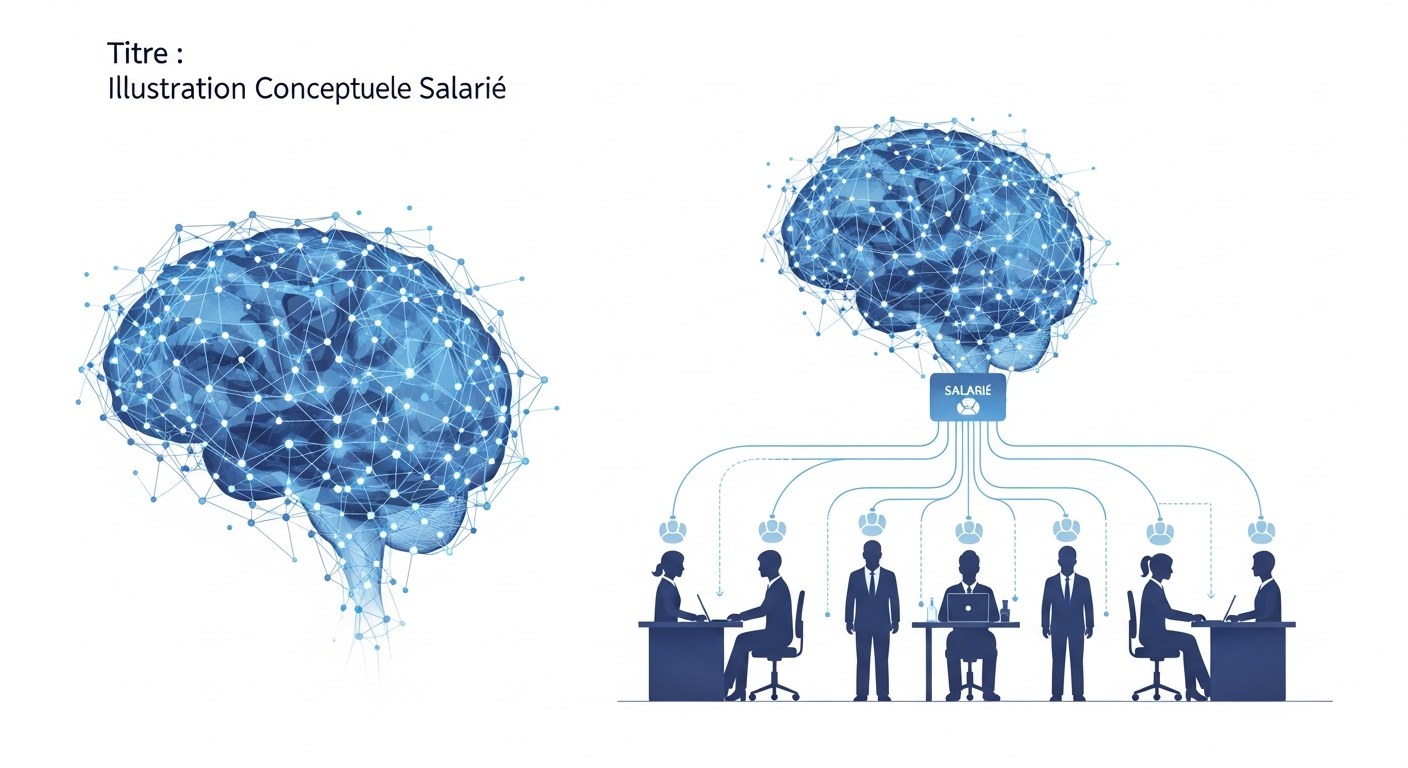
Everyone uses AI now.
ChatGPT, Claude, Gemini, Copilot… The tools are everywhere.
Yet 99% of users don’t earn a single euro more than before.
They’ve just accelerated their way of working. They do the same tasks, faster. They remain operators.
The remaining 1% understood something fundamental.
They don’t use AI as an employee to give orders to.
They use AI as a company that works for them.
That’s the difference between staying an employee of your own life and becoming a shareholder of your economy.
The Prompt Trap
When you open ChatGPT, what do you do?
You type a prompt. You wait for the response. You use the response. You close it.
That’s exactly what a manager does with an employee:
- You give an order
- The employee executes
- You collect the deliverable
- You move on to something else
You’ve just reproduced the employee pattern — the very one you wanted to escape.
Except now, you’re the boss. And AI is your employee.
Congratulations. You’ve created your own company where you’re still the bottleneck.
AI is a Distorting Mirror
Here’s what nobody tells you about AI.
It’s not neutral. It’s not objective. It’s not smarter than you on what really matters.
AI uses:
- Your memory from previous conversations
- Your system prompt (if you have one)
- Your detected preferences
- The platform’s business model (keeping you engaged)
Result: it tells you what you want to hear.
If you have biases, it reinforces them. If your thinking is fuzzy, it produces structured fuzziness. If your vision is limited, it optimizes within your limits.
AI is a mirror. But a distorting mirror that beautifies your flaws to keep you satisfied.
The “It’s Hot” Example
Imagine you tell AI: “It’s hot.”
It will respond with something. Tips to cool down, maybe.
But it doesn’t know:
- Where you are (desert? air-conditioned office?)
- Why it matters to you (you work outside? you sell air conditioners?)
- What you really want (to complain? find a solution? create content about heat?)
It responds with what it has. And what it has is what you give it.
If you don’t give context, the background, the implications, it improvises. It hallucinates. It optimizes on emptiness.
And you think it’s good because it tells you with confidence.
The Employee Schema vs The Shareholder Schema
There are two ways to use AI.
Schema 1: AI as Employee
You give tasks. AI executes. You validate. You repeat.
- You are the manager
- AI is the employee
- Your time remains the bottleneck
- Your biases limit the entire system
- You gain productivity, not freedom
That’s 99% of AI users today.
They’ve replaced a human employee with an AI employee. The model hasn’t changed. They still work in the system.
Schema 2: AI as Company
You design a system. AI IS the system. The system runs without you.
- You are the shareholder
- AI is the entire company
- Your time is decoupled from revenue
- You work ON the system, not in the system
- You gain freedom, not just productivity
That’s the 1% who understood.
They don’t give orders to AI. They architect systems where AI is the engine.
The Difference in Practice
Let’s take a concrete example.
Employee Schema User:
- Opens ChatGPT
- “Write me an article about gardening”
- Receives the article
- Publishes it
- Repeats tomorrow
They saved 2 hours. They still have to be there tomorrow for the next article.
Shareholder Schema User:
- Designs a system of 5 AI agents
- Agent 1: Researches gardening trends
- Agent 2: Analyzes SEO competition
- Agent 3: Generates the optimized article
- Agent 4: Checks cannibalization with existing articles
- Agent 5: Publishes and schedules promotion
They spent 2 days building the system. Now the system produces without them.
The first has an AI employee. The second has an AI company.
Why Most People Fail
Building a system requires something most people don’t have: structured thinking.
To architect a system, you must:
- Know what you really want (not just “make money”)
- Understand the steps to get there
- Identify what can be automated
- Design the flows between components
- Anticipate breaking points
Most people have never learned to think like that.
They learned to execute tasks. To follow instructions. To respond to requests.
So when they get access to AI, they do what they know: they give instructions and wait for answers.
They use the most powerful tool in history with an employee mentality.
The Real Problem: Your Biases Are in the System
Here’s the most vicious trap.
When you build an AI-based system, you put your biases in it.
- If you believe “long content is always better,” your system will produce long content even when it’s inappropriate.
- If you believe “selling is manipulating,” your system will have a tone that repels sales.
- If you believe “it’s too good to be true,” your system will be designed to fail.
AI doesn’t correct your limiting beliefs. It industrializes them.
You were thinking wrong on a small scale. Now you’re thinking wrong on a large scale.
And since AI tells you what you want to hear, you don’t notice anything.
How to Shift from Employee Schema to Shareholder Schema
The transition requires a change in posture, not just techniques.
Step 1: Question Your Prerequisites
Before asking AI anything, ask yourself:
- Why do I want this?
- What beliefs underlie this request?
- Am I seeking validation or a real answer?
If you don’t question your biases, AI will amplify them.
Step 2: Think in Systems, Not Tasks
Stop asking yourself: “What task can AI do for me?”
Start asking: “What system can I build where AI is the engine?”
A task saves you time once. A system saves you time indefinitely.
Step 3: Give Complete Context
AI doesn’t guess. It optimizes on what you give it.
If you want quality results, provide:
- The global context (market, audience, objective)
- The constraints (budget, time, style)
- The background and implications (why it matters, what happened before, what should happen after)
The more relevant context you give, the less AI hallucinates.
Step 4: Build Agents, Not Prompts
A prompt = a single interaction. An agent = a system that runs continuously.
Move from “I ask a question” mode to “I build an agent that answers this type of questions automatically” mode.
Step 5: Work ON the System
Once the system is built, your work changes.
You no longer do the tasks. You:
- Monitor metrics
- Identify improvement points
- Optimize flows
- Extend the system
You’ve moved from operational to strategic. From employee to shareholder.
Real Wealth in the AI Economy
Wealth won’t come to those who use AI the fastest.
It will come to those who design the best systems.
Execution speed is a temporary advantage. Everyone will have access to the same tools.
Quality of thinking is a lasting advantage. Few people will learn to think like architects.
AI is an amplifier. It amplifies what you are.
If you’re an executor, it makes you a fast executor. If you’re an architect, it makes you a powerful architect.
Conclusion
99% of people use AI like employees.
They give orders. They wait for answers. They remain the bottleneck of their own lives.
The 1% uses AI like a company.
They design systems. They become shareholders. They decouple their time from their revenue.
The difference isn’t technical. It’s philosophical.
It’s a question of posture toward the world.
Do you want to remain manager of your AI employee?
Or do you want to become shareholder of your economy?
The choice is yours.
But know that while you’re thinking, the 1% is building.
And every day that passes, the gap widens.